


Taxation for Turkish Citizenship Investors: The Legal Guide (2026)
Publication Date: December 2, 2025 |
Updated: January 3, 2026 |
| 4 minutes
The most common concern for high-net-worth investors is taxation. Does acquiring a Turkish passport automatically make you liable for taxes on your worldwide income?
The short answer is No.
Under Turkish Tax Law, citizenship and tax residency are two separate legal concepts. Holding a Turkish passport does not automatically make you a “Full Tax Resident.” This guide clarifies the tax liabilities for investors and explains the difference between “Limited” and “Full” tax liability.
The Golden Rule: Citizenship vs. Tax Residency
Turkey applies a residency-based taxation system, not a citizenship-based one (unlike the USA).
1. Limited Tax Liability (Non-Resident Investors)
If you acquire Turkish citizenship by investment but do not live in Turkey for more than 6 months in a calendar year, you are considered a “Limited Taxpayer” (Dar Mükellef).
- Result: You only pay tax on income generated inside Turkey (e.g., rental income from your Istanbul apartment).
- Global Income: Your income generated outside of Turkey (dividends, salaries, crypto assets abroad) is NOT taxed in Turkey.
2. Full Tax Liability (Resident Citizens)
If you decide to relocate and live in Turkey for more than 183 days a year, you become a “Full Taxpayer” (Tam Mükellef). In this case, your worldwide income may be subject to Turkish taxation, subject to Double Taxation Prevention Treaties.
Lawyer’s Note: Most of our clients remain “Limited Taxpayers” and enjoy the benefits of the passport without exposing their global wealth to Turkish taxation.
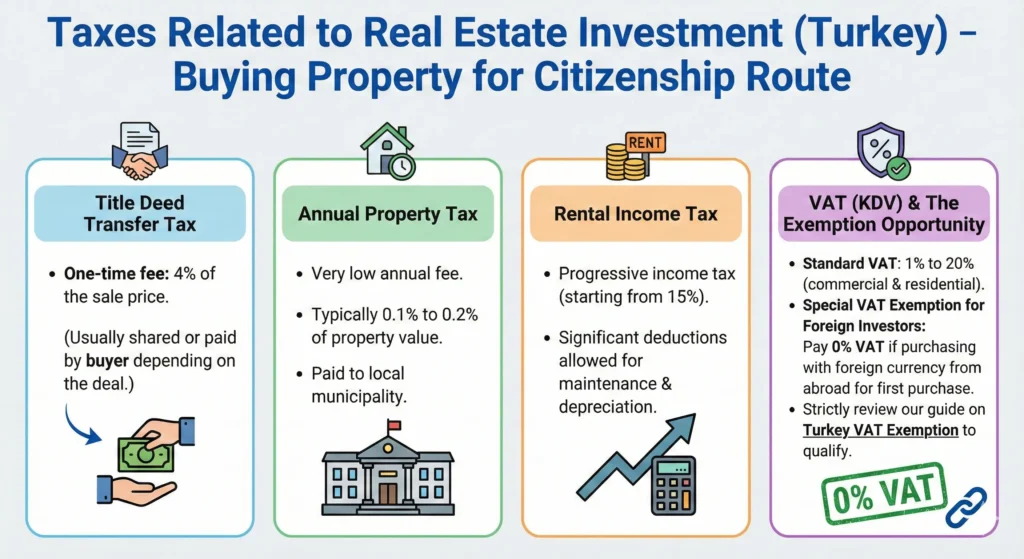
Taxes Related to Real Estate Investment
Since most investors choose the Buying Property for Citizenship route —the most preferred option among all Turkey Citizenship by Investment routes—you must be aware of the specific property taxes:
- Title Deed Transfer Tax: A one-time fee of 4% of the sale price (usually shared or paid by the buyer depending on the deal).
- Annual Property Tax: A very low annual fee, typically between 0.1% and 0.2% of the property value, paid to the local municipality.
- Rental Income Tax: If you rent out your investment property, the income is subject to progressive income tax (starting from 15%). However, significant deductions are allowed for maintenance and depreciation.
- VAT (KDV) & The Exemption Opportunity: The standard VAT rate on commercial and residential properties can range from 1% to 20%. However, foreign investors are granted a Special VAT Exemption. If you purchase the property using foreign currency brought from abroad and it is your first purchase, you can legally pay 0% VAT. This saves you significant capital. To see if you qualify and how to apply, strictly review our guide on Turkey VAT Exemption on Real Estate Purchase.
Capital Gains Tax: The 5-Year Exemption
If you decide to sell your property after the mandatory 3-year citizenship holding period, you should know the “Capital Gains Tax” rules:
- Before 5 Years: If you sell the property within 5 years of purchase, the profit is taxed.
- After 5 Years: If you hold the property for 5 full years, the profit is 100% Tax-Exempt.
Strategy: We often advise clients to hold the asset for 5 years (instead of just the mandatory 3) to maximize ROI by avoiding capital gains tax legally.
Double Taxation Prevention Treaties
Turkey has signed “Prevention of Double Taxation Treaties” with over 85 countries, including the UK, USA, Germany, China, and Russia.
- Benefit: Even if you become a tax resident in Turkey, taxes paid in your home country are credited against Turkish tax liabilities, ensuring you never pay tax twice on the same income.
- For the official list of treaties, you can consult the Turkish Revenue Administration
Frequently Asked Questions
Is there an Inheritance Tax in Turkey?
Yes, but it is comparatively low compared to Europe. Inheritance tax ranges from 1% to 10% depending on the value of the asset and the relationship to the deceased.
Does Turkey tax Crypto Assets?
As of 2026, there is no specific specific “Crypto Tax” for individual investors holding assets for long-term periods, though regulations are evolving. Currently, it is a tax-friendly environment for digital assets compared to the EU.
Do I need a Tax ID Number?
Yes. Every investor receives a Tax ID number (Vergi Kimlik Numarası) before purchasing property. This does not trigger tax liability; it is merely for registration purposes.
Can I open a bank account without living in Turkey?
Yes. With your Tax ID and Passport, we can assist you in opening accounts in major Turkish banks to manage your investment funds.



Legal Information
This Briefing is for Informational Purposes; it is not Legal Advice. If You Have any Questions, Please Contact Us. All Rights Reserved.
You May Be Interested In